

You're usually asking what is solana api at the exact moment Solana starts feeling less simple than the docs make it sound.
You query a wallet balance, then realize SOL is only part of the picture. You need SPL tokens too. Then someone asks for NFT support, transaction history, live updates, and DeFi positions. Suddenly “just call the chain” turns into node quality, confirmation levels, parsing program data, and deciding whether raw RPC is enough for the product you're building.
That's why it helps to stop thinking about the Solana API as one thing. It's a stack. Some parts let you talk directly to a node. Other parts translate raw chain activity into something a product can use.
The Solana API Explained A Developer's Entry Point
A Solana API is the communication layer between your app and the Solana blockchain. If the blockchain is the kitchen, the API is the waiter. Your app asks for something specific, such as a balance, a transaction record, or a subscription to account changes. The API carries that request to the chain and brings back a response your code can handle.
That sounds simple, but there's an important catch. Solana doesn't have one single API surface. In practice, you work with a few different interfaces depending on whether you want to ask for data or listen for events.
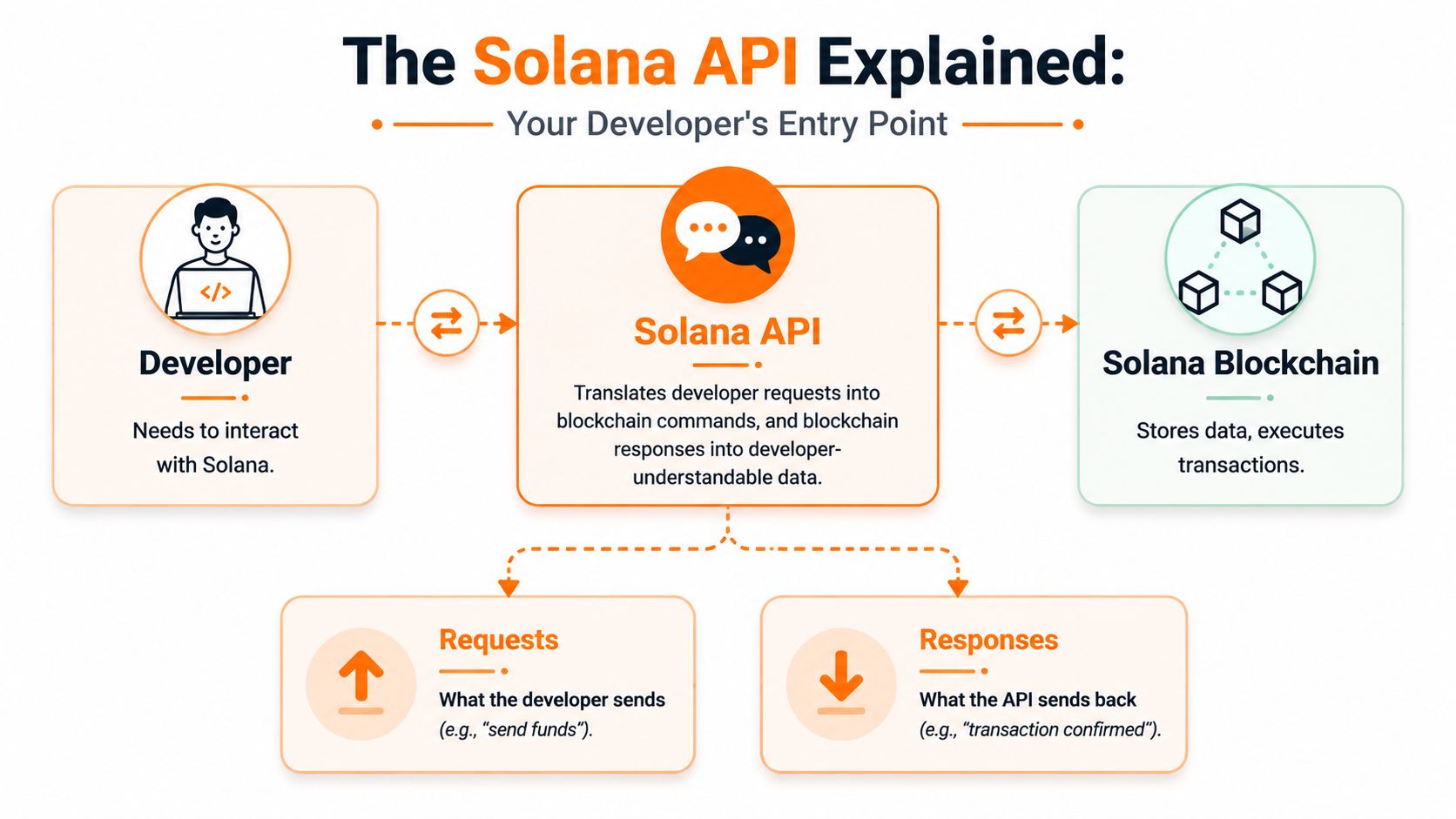
Two ways your app talks to Solana
The first is JSON-RPC. This is request and response. You ask, “What's the balance of this address?” or “Send this transaction.” The node answers with structured JSON.
The second is WebSocket. This is push-based. Instead of repeatedly asking whether something changed, your app subscribes to updates and gets notified when an account, slot, or transaction event appears.
A useful mental model is this:
- JSON-RPC is for deliberate questions.
- WebSocket is for live monitoring.
- Higher-level APIs exist because raw answers often aren't product-ready.
Practical rule: If your UI refreshes only when a user clicks or lands on a page, JSON-RPC may be enough. If the screen needs to move the moment the chain changes, use subscriptions.
Why the API structure looks this way
Solana is built for high-throughput interaction, so the API reflects that. Developers need fast reads, fast writes, and event streams that don't force the client to poll constantly. That's why provider docs often split their offerings into standard RPC, streaming, and enriched data layers.
That distinction matters early. Teams lose time when product requirements are written as if “API integration” means one endpoint family. It rarely does. A wallet, tracker, or exchange feature usually touches direct node access, real-time subscriptions, and some form of indexed or parsed data.
If you're documenting those handoffs across engineering and product, a solid template for product managers can help clarify which layer owns each requirement before implementation starts.
What beginners usually get wrong
Most new teams assume the API returns human-friendly business data by default. It often doesn't. Raw Solana endpoints are close to chain state, not close to user intent.
That's why “show me everything in this wallet” is much harder than “get me this account.” The first is a product problem. The second is a node query.
Understanding Solana's Core Concepts for API Interaction
Solana's API makes more sense once you see what the chain is optimizing for. A validator is serving state from a very fast system built around ordered execution, explicit account access, and short feedback loops. That is why the API feels closer to database reads and execution traces than to the object-style interfaces many web developers expect.
Accounts are storage units
On Solana, an account is a storage record with an address, owner, balance, and data field. A wallet is just one account type. Token accounts, program state, NFT metadata, escrow records, and order books all use the same base model.
A filesystem comparison fits here. The chain is the machine, accounts are files, and programs define which files they can read or write. That design explains why RPC methods keep asking for addresses and raw data. The node is exposing chain state close to how the runtime stores it.
This is also where new teams misread the API. They ask for "a user's tokens" or "all swap activity" as if the chain keeps product-level objects ready to return. It does not. You usually start with accounts, then add decoding, indexing, and protocol-specific parsing on top.
Transactions are signed instruction bundles
A transaction is a container for one or more instructions. Each instruction names a program to execute and the accounts that program will touch. Solana requires those account references up front because the runtime needs to know what data is involved before execution.
That choice has a direct API consequence. Transaction responses are great for proving what ran, but not always great for telling you what the user meant.
A single swap can route through several programs, create or close token accounts, pay fees, and emit logs. The raw payload is accurate. The product meaning still has to be inferred.
Treat transactions as execution packets. If your app needs labels like “swap,” “stake,” or “mint,” build a parsing layer or use a provider that already does that work.
Programs hold logic. Accounts hold mutable state.
Solana smart contracts are called programs, and the important API implication is simple. Programs usually do not store mutable state inside the deployed code. They operate on external accounts.
That is why Solana integration work often starts with two questions: which accounts matter, and how is their data encoded? On EVM chains, developers often read contract variables through an ABI and expect a tidy response. On Solana, you often need the program's account layout, PDA derivation rules, and token account relationships before an RPC response becomes useful.
The SPL ecosystem reduces some of that friction because common token behaviors follow shared conventions. Even then, a wallet balance view is really a query across token accounts, mint metadata, and ownership rules. If you want a quick reference for how end-user products summarize that data, the Solana asset page on CoinStats is a practical example of the difference between raw chain state and a user-facing asset view.
Proof of History and parallel execution shape the API
Solana's architecture is a big reason the API is split the way it is. Proof of History helps the network order events efficiently, and the account model lets validators execute many non-overlapping transactions in parallel. The API reflects those priorities. You get slot-based context, commitment levels, block and transaction status methods, and subscription options because clients need to reason about recency, ordering, and finality.
In practice, this means two reads can both be correct and still disagree for a short period if they were served at different points in the chain's progression. That is normal behavior on Solana. Good integrations treat freshness and finality as explicit choices, not hidden assumptions.
Commitment levels change product behavior
Commitment is one of the first settings that affects user trust. Solana defines standard commitment levels such as processed, confirmed, and finalized, as described in the Solana commitment status documentation.
The practical trade-off is straightforward:
- Use
processedfor low-latency UX where showing the newest state matters more than settlement guarantees. - Use
confirmedfor many interactive reads where you want a stronger signal without waiting for full finality. - Use
finalizedfor balances, history, accounting, or any record your product should treat as settled.
Mixing these casually creates support issues. A balance can appear, disappear, then reappear depending on which screen queried which commitment level. Teams often call that an RPC bug. In production, it is usually a product decision that was never made explicitly.
Exploring Common RPC Endpoints and Example Requests
A common first-week mistake looks like this: the app shows a zero balance, the wallet definitely has funds, and the bug report says RPC is unreliable. In practice, the request often hit the wrong cluster, used the wrong commitment, or asked for data in a format the product could not interpret cleanly.

Start with the right cluster
Solana RPC uses JSON-RPC 2.0, but the bigger decision is which network you are talking to. The public clusters are:
- Mainnet at
https://api.mainnet-beta.solana.com - Devnet at
https://api.devnet.solana.com - Testnet at
https://api.testnet.solana.com
Use Devnet for faucet-funded testing and disposable state. Use Mainnet for anything tied to real balances, production transactions, or customer support. Testnet exists mainly for validator and network testing, so it is usually the wrong place for product QA.
This choice matters more on Solana than many teams expect. A wallet address can exist on one cluster and mean nothing on another. If the data looks impossible, verify the cluster before blaming the node.
A basic balance request
getBalance is the first method to learn because it shows several Solana API patterns at once: explicit commitment, slot context, and raw units.
{ "jsonrpc": "2.0", "id": 1, "method": "getBalance", "params": [ "YourWalletAddressHere", { "commitment": "finalized" } ]
}
A typical response looks like this:
{ "jsonrpc": "2.0", "result": { "context": { "slot": 123456 }, "value": 2500000000 }, "id": 1
}
The value is in lamports, not SOL. The context.slot field matters too. Solana returns the slot that produced the answer because recency is part of the answer. If two backend services read at different slots, they can disagree briefly without either one being wrong.
For user-facing balances, teams should choose one commitment level and use it consistently across screens. Mixed commitments create support tickets fast.
Listing SPL token accounts
getTokenAccountsByOwner is where Solana's account model stops being abstract and starts shaping your integration.
{ "jsonrpc": "2.0", "id": 1, "method": "getTokenAccountsByOwner", "params": [ "YourWalletAddressHere", { "programId": "TokenkegQfeZyiNwAJbNbGKPFXCWuBvf9Ss623VQ5DA" }, { "encoding": "jsonParsed" } ]
}
You are not querying a built-in wallet portfolio object. You are asking for accounts owned by an address that belong to the SPL Token program. That design comes straight from Solana's account model. State lives in accounts, programs define how to read and mutate that state, and RPC exposes those pieces directly.
jsonParsed is convenient during development because it saves time. The trade-off is control and sometimes performance. Many production indexers prefer raw or base64 account data, then decode it themselves so the parsing logic stays stable even when provider behavior differs.
Before the next example, this walkthrough is worth watching:
Another gotcha: token ownership on Solana usually means ownership of one or more token accounts, not direct balances attached to the system wallet address. If your product model assumes Ethereum-style balance lookups, this endpoint will expose that mismatch quickly.
Reading transaction details
getTransaction gives the execution record for a known signature.
{ "jsonrpc": "2.0", "id": 1, "method": "getTransaction", "params": [ "TransactionSignatureHere", { "commitment": "confirmed", "encoding": "json" } ]
}
This response is useful for debugging, confirmations, and audit trails because it includes slot information, status metadata, logs, and instruction data. It is less useful as a direct product event feed. Raw transaction records tell you what the chain executed. Your app still has to decide whether that means "swap completed," "NFT minted," or "payment received."
That distinction matters in production. RPC gives protocol-shaped data because Solana is optimized around fast execution and explicit state, not around prebuilt business events. Teams that need clean historical activity, decoded transfers, or wallet-level summaries usually add an indexer or specialized data API on top of basic RPC.
Choosing Your Solana API Provider Self-Hosted vs Third-Party
Sooner or later, every team has to decide whether to run its own Solana infrastructure or rent access from someone who already does.
The short version is simple. Self-hosting gives control. Third-party providers give speed to production. Neither is automatically right.
The infrastructure side of Solana improved a lot after 2022. According to the Solana 2022 recap referenced here, later provider offerings pushed reliability to 99.99% uptime and 2x higher throughput for low-latency apps, part of the broader maturation that supported a network cited there at 2.0M daily active users and $60.9B market cap by 2026. The practical consequence is that third-party access is no longer just a shortcut for prototypes. For many teams, it's the default operating model.
What self-hosting really means
Running your own node sounds attractive because there are no vendor rate limits and no black-box infrastructure choices. You also control upgrades, caching strategy, and internal observability.
But it's the hard path. You own maintenance, reliability, failover, and operational troubleshooting. If the app slows down at the same time your team is shipping product features, node operations become a second product whether you wanted one or not.
What third-party providers actually buy you
A managed provider removes most of that operational burden. You get hosted RPC, often better geographic routing, and usually extra services like indexed data, WebSockets, and token or NFT APIs.
The trade-off is dependence. If their parsing is opinionated or their plan limits hit your traffic pattern, your architecture bends around their product.
API Provider Comparison
| Factor | Self-Hosted Node | Third-Party Provider |
|---|---|---|
| Control | Full control over node setup and policies | Limited to provider features and plan limits |
| Maintenance | Your team handles upgrades, monitoring, and reliability | Provider handles infrastructure operations |
| Performance tuning | Customizable if your team has the expertise | Usually strong out of the box |
| Time to ship | Slower | Faster |
| Failure mode | Internal ops burden | External dependency risk |
| Best fit | Infra-heavy teams with specialized needs | Most product teams shipping user-facing apps |
If your product's differentiation is not node operations, don't accidentally turn node operations into your core competency.
Beyond Basic RPC Advanced Data and Specialized APIs
A common failure mode looks like this. The app can fetch SOL balances and send transactions, but the first real product request breaks the model: complete wallet history, parsed swaps, NFT holdings, token metadata, and search across old activity. Raw RPC can answer pieces of that. It does not package them in a way a user-facing product can ship quickly.
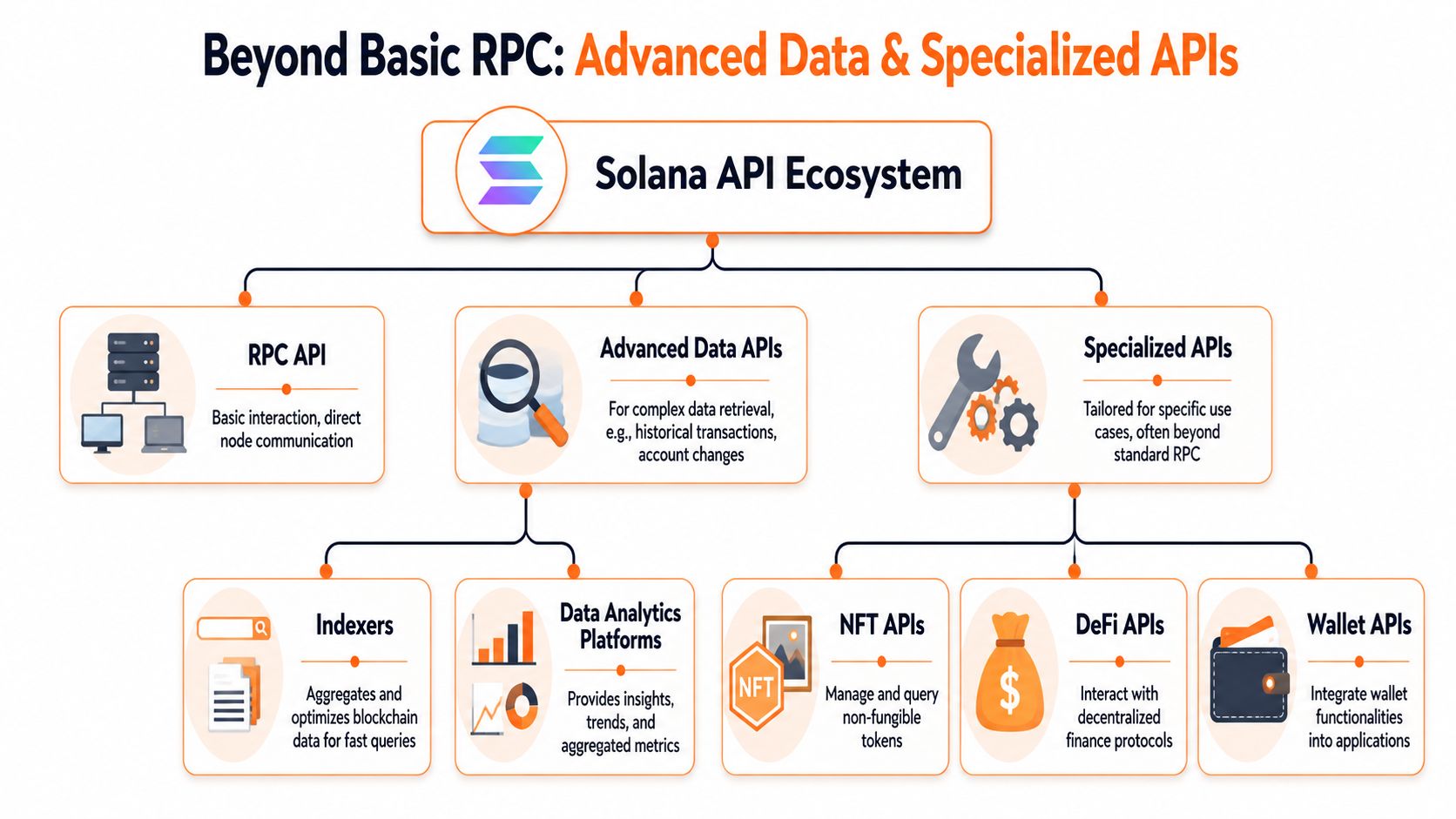
Solana's architecture is part of the reason. The chain is optimized for high throughput, and the account model stores state in a form that is efficient for programs and validators, not for product queries like “show me every swap this wallet made across protocols.” RPC exposes the chain's native shape. Product teams usually need a second layer that reindexes, parses, and joins that data into something queryable.
That is why the ecosystem split into three practical categories. Basic RPC talks to the chain. Indexed APIs reshape chain data for search, history, and portfolio views. Specialized APIs go one step further and understand a domain such as NFTs, token prices, or DeFi activity.
Where raw RPC starts costing real time
You can build those higher-level views yourself. Teams do it for compliance pipelines, custom analytics, and protocol backends that need exact control over parsing rules. The cost is maintenance. You own ingestion, backfills, parser bugs, schema changes, and every protocol-specific edge case.
Compressed NFTs make the limitation obvious. Basic account reads often miss the asset view your users expect, especially once ownership and metadata have to be reconstructed across compression-specific structures. Helius documents this directly in its Digital Asset Standard API, which exists because asset queries are a different problem from raw validator queries.
What advanced APIs actually add
The useful features are not just “more endpoints.” They remove work your team would otherwise do off-chain:
- Indexed history for transfers, swaps, and holdings across time
- Parsed transactions that map instruction data into readable events
- Asset metadata so tokens and NFTs render as products, not opaque addresses
- Protocol-aware enrichment for positions, pools, and wallet activity
- Search-oriented query models that are hard to reproduce efficiently on top of plain RPC
For teams building portfolio or trading experiences, this is the difference between exposing raw chain internals and showing a clean asset view like Jupiter market data on CoinStats.
DAS and domain-specific APIs
DAS is the clearest example of Solana's API structure following Solana's data model. Instead of asking you to walk accounts and metadata manually, a Digital Asset Standard endpoint lets you query around the asset itself. That fits wallet apps, NFT dashboards, tax tools, and analytics products much better than low-level RPC methods do.
The same pattern shows up elsewhere. DeFi teams often use parsed transaction feeds or protocol-specific APIs because raw instructions are too expensive to normalize repeatedly at request time. Wallet teams use indexed balance and history services because users ask asset questions, not validator questions.
There is a trade-off. Every layer above RPC adds convenience and some provider dependence. Parsing can be opinionated. Data freshness can lag the tip of the chain. Coverage can vary by protocol. That is why mature teams separate concerns: RPC for writes and state verification, indexed APIs for history and UX, specialized APIs where the domain is too complex to rebuild cheaply.
If you expose these APIs to clients or internal services, secure your APIs before traffic grows. Indexed and specialized endpoints tend to aggregate more sensitive usage patterns than a simple balance lookup.
Production-Ready Best Practices Performance and Security
A Solana integration that works in a demo can still fail in production for ordinary reasons. Wrong commitment level. Too much polling. Weak retry logic. Secrets exposed in the wrong place.
The fix isn't one trick. It's discipline.
Performance habits that actually help
For real-time use cases, subscriptions matter more than brute-force polling. The Moralis Solana reference notes that, through DAS-oriented and related real-time patterns, developers can use accountSubscribe to get sub-100ms latency on token transfers while reducing polling overhead by 90%. That's exactly the kind of improvement that changes whether a portfolio screen feels live or laggy.
A few habits hold up well:
- Prefer subscriptions for hot paths when balances, token accounts, or live activity need immediate updates.
- Use polling sparingly for background syncs or low-priority refreshes.
- Separate read freshness from settlement certainty so your app doesn't use the same commitment level everywhere.
- Estimate fees dynamically when you're sending transactions into congestion, especially for swaps or time-sensitive actions.
Fast apps don't ask the node the same question over and over. They subscribe where it matters and reconcile where it doesn't.
Security mistakes worth avoiding
The most common Solana security errors aren't exotic. They're ordinary web mistakes brought into a crypto app. Don't expose private keys client-side. Don't trust wallet addresses or token inputs without validation. Don't assume a parsed response means a safe response.
If your team wants a compact checklist for the basics, this guide on how to secure your APIs is a useful complement to chain-specific practices.
Reliability comes from boring decisions
Treat provider errors, empty responses, and stale reads as normal conditions. Log enough context to reproduce failures. Decide in advance which screens tolerate temporary inconsistency and which ones must wait for stronger confirmation.
That's the difference between a side project and a product users trust with money.
Putting It All Together Your Solana Integration Path
A Solana integration usually gets simpler once the team stops treating “the Solana API” as one thing.
At the base layer, RPC is for chain facts. It answers questions like: what does this account hold, what slot are we on, did this transaction land, what program owns this account. That shape comes directly from Solana's design. The chain is optimized around accounts, recent blockhashes, parallel execution, and very fast slot production, so the API exposes low-level state and transaction plumbing first. That is great for infrastructure work. It is not enough for a product screen that needs history, labels, PnL, or protocol-specific context.
The next layer is live delivery. WebSocket subscriptions matter when your app cannot wait for another read cycle, such as wallet activity, token account changes, or order flow around a trading interface. After that, many teams add indexed or specialized APIs because raw account data still leaves too much interpretation work in the application. NFT traits, DeFi positions, decoded swap activity, and portfolio views usually come from systems that ingest RPC data and organize it around user questions.
That is why different provider types exist. A self-hosted RPC setup gives you control, but it also gives you validator tuning, index limits, storage decisions, and on-call responsibility. A third-party RPC provider reduces operational load, but you still need to check rate limits, method support, archive access, and how they behave under traffic spikes. Specialized data providers sit on top of that stack and trade raw flexibility for faster product development.
You can see that layering in real products. CoinStats Portfolio Tracker presents a wallet view that goes beyond what direct RPC returns by default, and a page like Raydium price and market data on CoinStats shows how protocol data gets reshaped into something an end user can read.
A practical path looks like this. Start with RPC for transaction submission and direct reads. Add subscriptions where timing changes the user experience. Add indexed data only when the product needs interpretation, cross-account joins, or historical views that would be expensive to build from raw responses alone.
That sequence keeps the architecture honest. Use Solana RPC for what the chain exposes. Use higher-level APIs for the meaning your users expect.

You can get bonuses upto $100 FREE BONUS when you:
💰 Install these recommended apps:
💲 SocialGood - 100% Crypto Back on Everyday Shopping
💲 xPortal - The DeFi For The Next Billion
💲 CryptoTab Browser - Lightweight, fast, and ready to mine!
💰 Register on these recommended exchanges:
🟡 Binance🟡 Bitfinex🟡 Bitmart🟡 Bittrex🟡 Bitget
🟡 CoinEx🟡 Crypto.com🟡 Gate.io🟡 Huobi🟡 Kucoin.










Comments